E A S T E R T H R I L L E R
Polar Silence
The wind never stopped.
It clawed at the tent fabric like something alive, a constant, dry roar sweeping down from the polar ice.
The old mates had set out to reach the tip of Spitsbergen at the darkest time of the year. Now they had reached Verlegenhuken at the very winter solstice. Back in civilization, everybody was focusing on Christmas, food, drinks, and gifts. The contrast to their small Helsport Spitsbergen Camp 3 tent was satisfyingly huge.
Though, both being from mid-Norway, they had brought a small bottle of Aquavit (or was it home-brew?) to celebrate.
The last couple of days had been strange. The GPS had gone bananas, and they had been forced to rely on maps and a compass. Not easy in the faint light grazing the area at this time of the year. But they had found the maritime marker at the very tip. So they had made it!
Then they retreated a bit up in the hillside to shelter from the persistent northeast wind from the polar sea.
Bengt lay awake, counting gusts, feeling each one shudder through the double tentpoles. Rune slept in bursts beside him, muttering occasionally, his breath frosting the inner wall.
Then came the sound. Not wind. Not ice.
A deep, metallic groan—followed by a crack that seemed to split the world. Bengt’s eyes snapped open. “Did you hear that?” Rune was already sitting up. “Yeah.”
Another crack. Then a distant, muffled thud. They didn’t speak again. They dressed.
Outside, the polar night stretched in deep blue silence, the horizon barely distinguishable from the sky. The wind cut through their layers instantly. Bengt raised his headlamp but dimmed it—instinct.
Out on the frozen expanse of Wijdefjorden, the ice was breaking.
Not drifting. Not shifting.
Breaking from below.
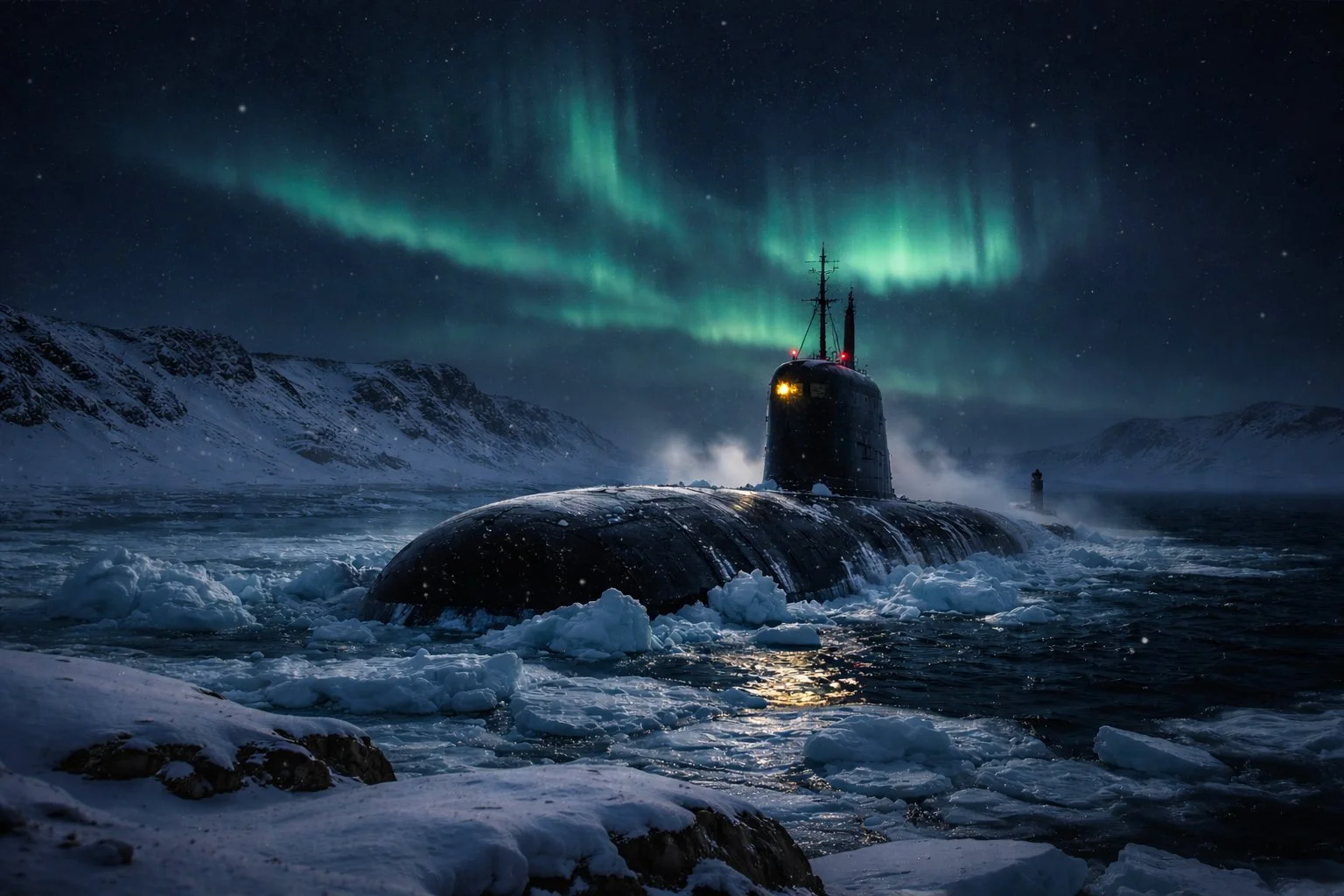
A black shape punched through first, shattering meters-thick ice like glass. Then another. And another.
Submarines!
They rose slowly, like beasts surfacing, their hulls gleaming wet in the dim light. Hatches opened. Figures emerged. Lights flickered—low, disciplined, red-filtered.
Rune swore under his breath. “That’s not—”
“No,” Bengt said. “That’s not a drill.”
Snowmobiles were unloaded. Crates. Weapons. Dozens—no, hundreds—of soldiers poured onto the ice and regrouped with terrifying efficiency.
The wind shifted.
Voices carried.
Russians?!
They froze.
No misunderstanding now.
They crawled backward, inch by inch, until the ridge swallowed the fjord from view. Only then did they stand and run—half sliding, half stumbling—back to the tent.
Inside, their world shrank to nylon walls and ragged breathing.
“Satellite phone,” Rune said.
No signal.
“InReach?”
Nothing. Dead silence. Jammed.
Bengt stared at the devices, then at Rune. “They’re blocking everything.”
Rune nodded slowly. “Then no one knows.”
For a moment, neither spoke. The enormity of it pressed down harder than the cold.
Then Bengt’s eyes sharpened. “Not everything.”
He dug into his pack, fumbled and pulled out a compact, VHF radio.
Rune blinked. “You brought that?”
“Mandatory on Greenland,” Bengt said. “Never took it out.”
He switched it on. Static hissed.
“Channel 16,” Rune said.
Bengt adjusted the dial. The emergency frequency.
He hesitated.
“If they’re listening—”
“They already own the sky,” Rune cut in. “Try.”
Bengt pressed transmit.
“Mayday, mayday. Ski expedition on Svalbard. Can anyone hear us?”
Static.
Wind.
Nothing.
He tried again.
“Mayday, mayday. This is a ski expedition near the northern tip of Spitsbergen. We have visual confirmation of multiple submarines and armed forces— repeat, armed forces—on the ice in Wijdefjorden. Request immediate relay to Norwegian authorities and the Sysselmester.”
Silence stretched.
Then—
“…SK923 here. We read you. Over.”
They stared at each other.
A plane.
Rune grabbed the radio. “SK923, this is the expedition. Do you copy? Russian forces are mobilizing. Snowmobiles heading south—likely toward Longyearbyen. Communications are jammed. You must alert authorities immediately.”
The reply came, edged with disbelief. “Say again—Russian forces?”
“Yes!” Rune almost shouted. “This is not an exercise!”
A pause.
“Confirm location.”
Rune repeated it, slower this time.
Another pause.
“Understood… attempting to relay…”
The signal cracked.
“SK923, do you copy?” Bengt said, grabbing the radio back.
Static swallowed the channel.
They tried again. And again.
Nothing.
The silence that followed was worse than before.
Rune leaned back, eyes closed. “Either they believed us… or they think we’re insane.”
Bengt didn’t answer. He was looking at the map.
“They’ll hit Longyearbyen first,” he said quietly. “Fast, decisive. Before anyone can react.”
Rune opened his eyes. “We can’t outrun snowmobiles.”
“No,” Bengt said. “But we can disappear.”
He traced a line south, then west.
“Across Wijdefjorden. Then toward Ny-Ålesund.”
Rune frowned. “That’s insane. Open ice, patrols—”
“And witnesses,” Bengt said. “If we make it there with proof…”
He pulled out his camera.
They hadn’t realized it, but in those frozen minutes on the ridge, Bengt had, like he always does taken photos. With his beloved Nikon
Clear enough.
Enough to start something.
Rune looked at the map again. Then at Bengt.
“Okay,” he said. “We go now.”
The crossing was a gamble.
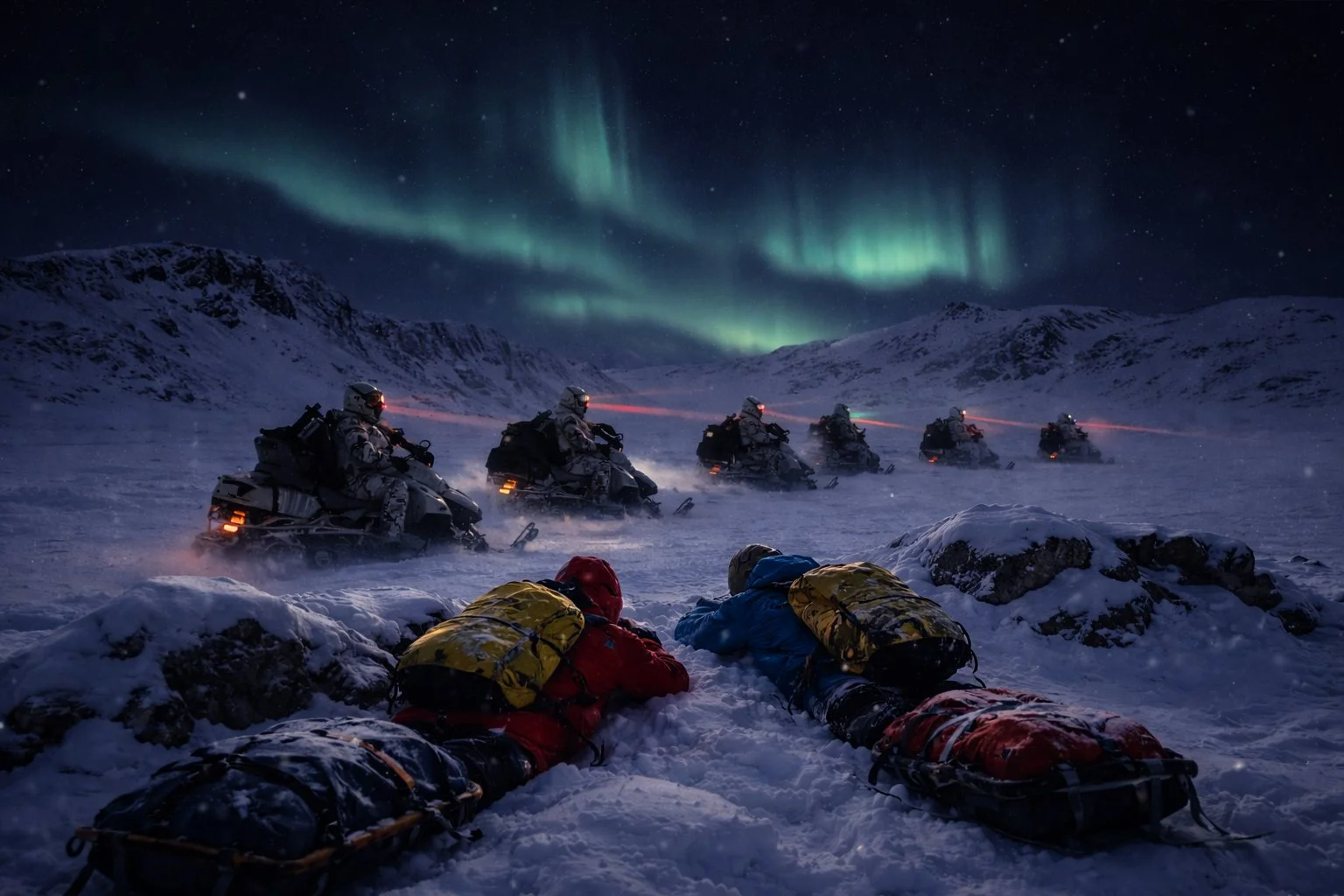
The fjord ice groaned beneath them, fractured and uneven from the submarines’ emergence. They moved without headlamps, navigating by faint starlight and compass bearings, every shadow a potential patrol.
Twice they dropped flat as snowmobiles roared in the distance.
Once, far too close.
Engines howled over the ice, headlights slicing through the dark. Bengt and Rune lay motionless behind a pressure ridge, hearts hammering so loud they were sure it would give them away.
The lights passed.
They did not move for ten minutes.
By the second day, exhaustion blurred everything. The cold gnawed deeper. Their world narrowed to the rhythm of skis and breath.
Then, finally—structures.
Ny-Ålesund.
Dim lights. Stillness. Civilization.
They staggered into the settlement like ghosts.
Within minutes, everything changed.
The local station took them in. Heated rooms. Radios that worked.
And when Bengt handed over the camera—
Silence.
Then urgency.
Calls. Messages. Satellites.
Within one hour, the footage was on its way to the mainland.
Within two, it would be everywhere.
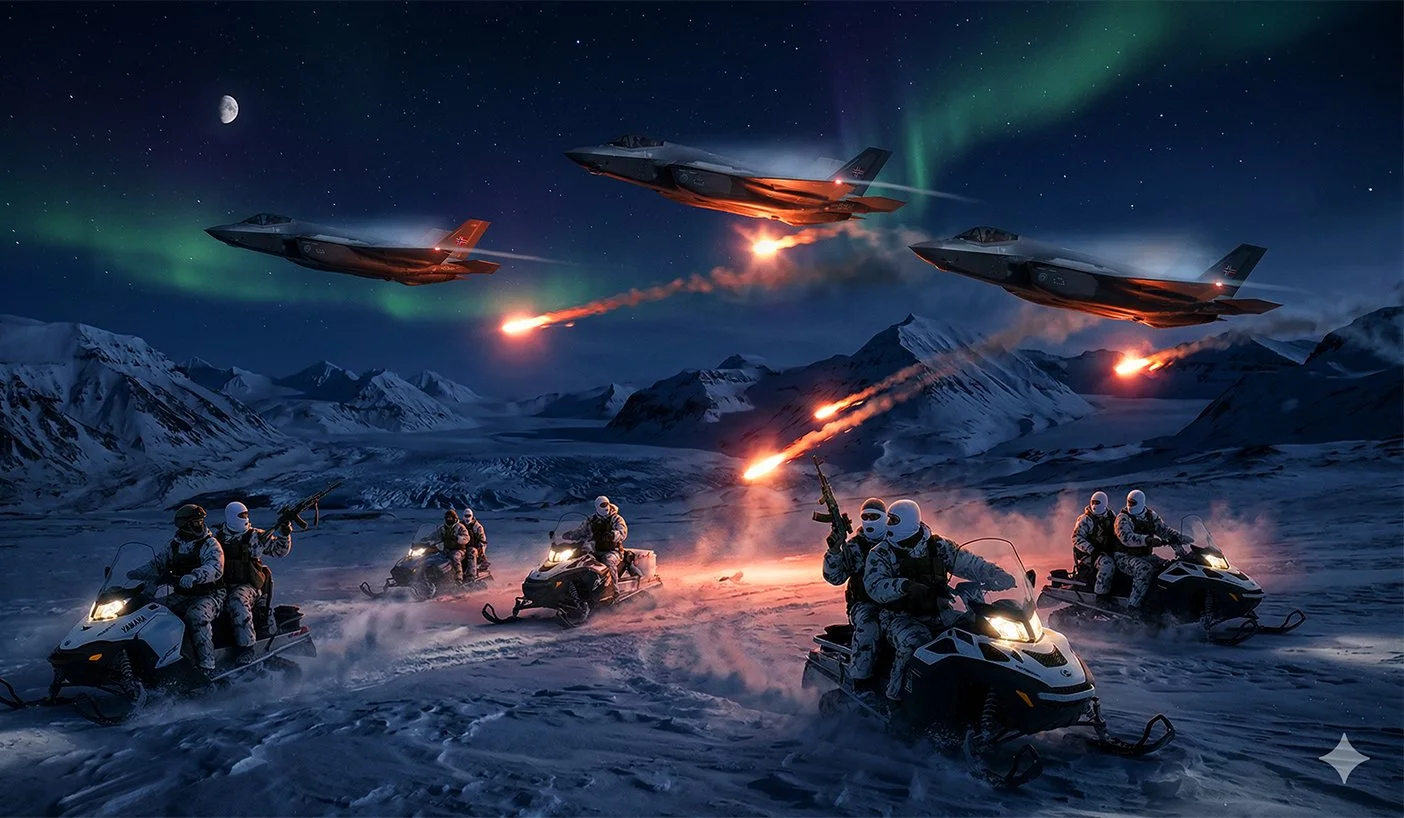
Far above the Arctic, jets screamed north.
From mainland Norway, from allied bases, from carriers hidden beyond the horizon.
Because the SAS flight had believed them.
SK923 had relayed the message before losing contact. Enough to trigger doubt. Enough to trigger verification.
And Bengt and Rune’s footage erased that doubt entirely.
Russian forces, already advancing toward Longyearbyen, suddenly faced something they hadn’t planned for:
Visibility.
And response.
—
By the time the first interceptors reached Svalbard airspace, the world was watching.
Diplomatic lines burned. Emergency sessions convened. Statements flew.
And then the words no one had expected to hear over a remote Arctic archipelago echoed across capitals:
Collective defense.
The line had been crossed.
—
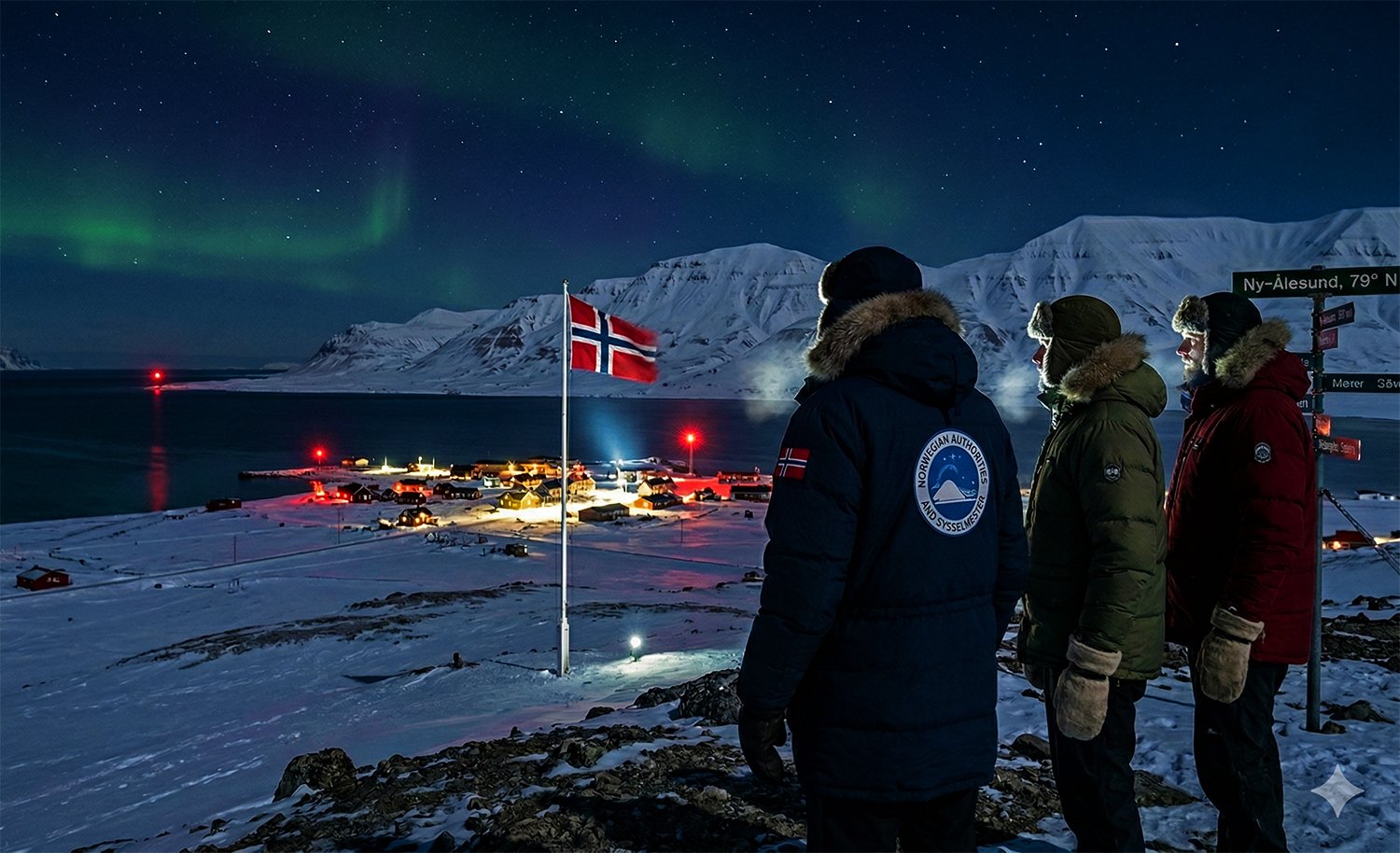
At first just a pale shimmer above the mountains, like breath on glass. Then it deepened—green ribbons unfurling across the sky, twisting and folding in slow, silent motion over Ny-Ålesund. The polar night, which had felt so absolute, now seemed alive.
Bengt and Rune stood outside, wrapped in heavy parkas, faces still marked by exhaustion and something else—something harder to name.
Behind them, the small settlement buzzed with activity. Radios crackled. Doors opened and closed. People moved quickly, purposefully. The world had arrived in the Arctic.
But out here, under the northern lights, it felt distant.
For a moment, neither of them spoke.
Rune finally broke the silence. “Hard to believe, isn’t it?”
Bengt nodded slowly. “Yesterday we were worried about compass drift.”
“And now…” Rune gestured vaguely southward, toward Longyearbyen, toward everything unfolding beyond their sight.
Bengt didn’t answer. His eyes followed the aurora as it rippled overhead.
Footsteps approached behind them.
They turned.
A man stepped out into the cold, pulling his coat tighter around him. His expression was tired, but steady. Familiar from news clips and briefings.
Sysselmester Lars Fause came to a stop beside them, looking up at the sky for a moment before speaking.
“The polar explorers were essential when Norway became independent,” he said quietly. “Now your community has again shown yourselves to be a great asset to our country.”
Bengt and Rune exchanged a glance, unsure what to say.
Fause continued, a faint smile tugging at his lips. “We haven’t always made life easy for people like you up here.” He glanced at them, a flicker of humor in his eyes. “We may have to review that.”
Rune let out a breath he didn’t realize he’d been holding and smiled. “Thank you… Then we’ll certainly be back next year.”
Fause gave a short nod, stepping back slightly, letting the moment settle.
Bengt looked up again, the green light reflecting faintly in his eyes.
“Yes,” he said softly. “It seems it’s important to visit this incredible archipelago while we can.”
The aurora surged brighter, washing the snow and ice in ghostly light.
For a long moment, the three men stood in silence beneath it—at the edge of the world, where a quiet ski expedition had shifted the course of something far larger.
The wind moved through the mountains.
And far beyond the horizon, history was still unfolding.